Buy the shuttlecock before you buy the racket, and buy shoes before either. The shuttle is the only piece of badminton equipment that changes how every other item on court behaves: a feather shuttle flies and decelerates on a completely different curve from a nylon one, and the racket, string tension and even your footwork get tuned to whichever you settle on. Most players get this backwards, spending on a racket first and treating shuttles as a consumable afterthought, then wondering why their game feels inconsistent across sessions.
The court and net set the dimensions every other purchase has to fit
A badminton court is 13.40 m long, and 6.1 m wide for doubles. The net stands 1.55 m at the posts and sags to 1.52 m at the centre. Those numbers are not trivia — they are the constraint that determines whether a racket, a pair of shoes or a home practice setup is actually fit for purpose.
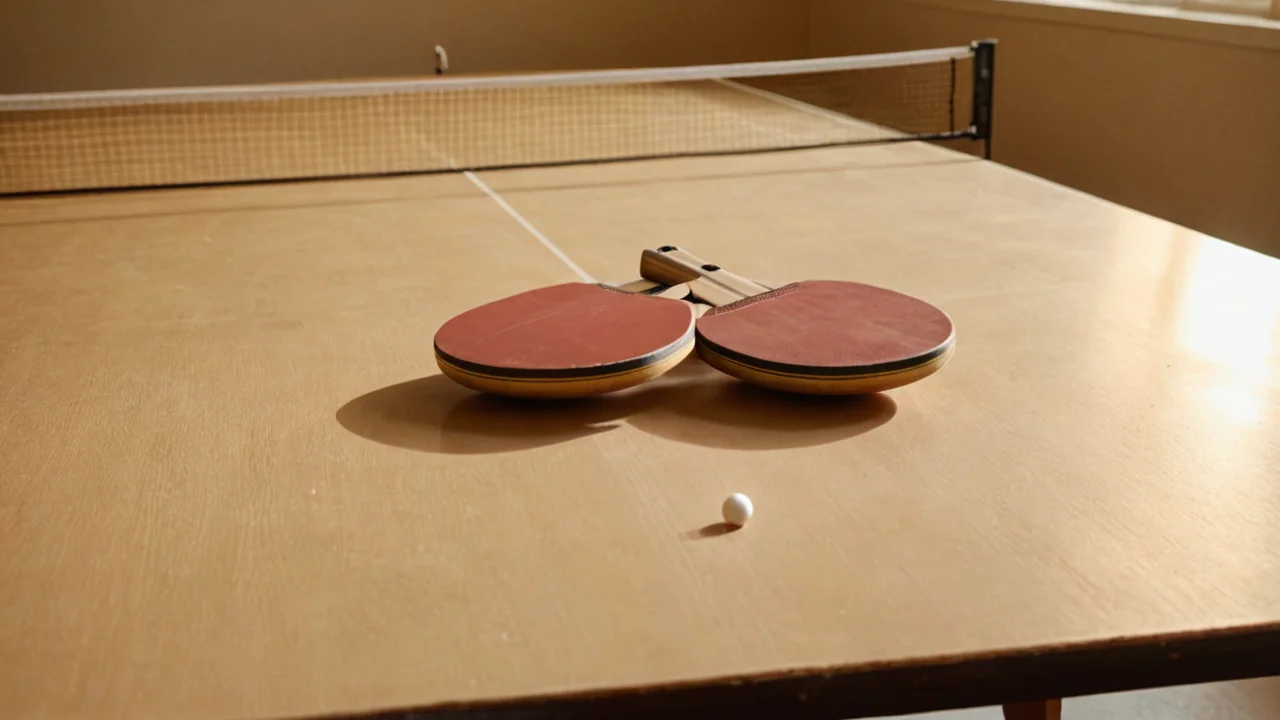
The net height matters more than beginners expect. At 1.55 m at the posts, the tape sits roughly at chest height on an average adult, which is why the overhead clear and the drop shot are both played from a contact point well above the net and why a racket that feels lovely swinging in a shop can feel sluggish the moment you have to lift it repeatedly to that height. The centre sag of 1.52 m is deliberate: it means the net is lowest exactly where most rallies are decided, in the front-court exchange, and a drop shot that just clears the tape at the centre has almost no margin. If you are setting up a net in a garden or hall, the post height is the number to get right first; a net strung too high at the posts changes the whole geometry of the front court.
The 13.40 m length and 6.1 m width are what make badminton a lung-burner rather than a gentle knockabout. For equipment, the practical consequence is that shoes and court surface matter far more than they do in a sport played on a smaller area. You cover the full length of that court in a lunge-and-recover pattern dozens of times per game, and a shoe built for running straight lines will roll at the ankle on the lateral push. If you take one thing from the dimensions, take this: buy court shoes with a gum rubber sole and a reinforced lateral cage, and save them for indoors. Wearing them outside destroys the grip in a couple of sessions.
The limits of all this: the official numbers describe a competition court. Club halls and school gyms are frequently marked to different tolerances, and a net set at the wrong height is the single most common reason a practice session feels off. Check the post height with a tape before you blame your racket.
The racket: length is capped, everything else is a trade-off
A badminton racket may not exceed 680 mm in overall length under the official laws. That cap is the only hard limit you will hit; every other specification — weight, balance, shaft stiffness, grip size, string tension — is a free variable, and that is where the real decisions live.
Rackets are sold by weight class, and the class is the first thing to get right. Heavier frames carry more momentum into the shuttle and suit players who generate their own power from a full overhead swing; lighter frames come round faster for defence and net play but give away punch on the clear. The mistake almost every improving player makes is buying the lightest, stiffest frame they can find because it feels fast in the shop, then discovering that a stiff shaft only rewards a player who can bend it. A stiff shaft on a slow swing is dead — you get no kick, the shuttle sits up short, and you blame your technique. A flexible shaft on a fast swing feels vague and wastes the whip you have. Match the shaft to your swing speed, not to your ambition.
Balance point is the second decision and it is separable from weight. A head-heavy frame in a light weight class gives you swing weight without total mass; a head-light frame gives you manoeuvrability at the net. Doubles players tend to drift toward head-light or even balance for the fast front-court exchange; singles players toward head-heavy for the deep clears and the sustained attack. Neither is wrong. The honest trade-off is that head-heavy frames tire your shoulder over a long session and head-light frames punish you if your technique relies on arm strength rather than timing.
Grip size is the most under-considered variable. Too small and you over-grip, which locks the wrist and kills the whip; too large and you cannot close the fingers on impact. If you find yourself with forearm soreness after a session and no obvious technique fault, check the grip before anything else. Over-grips are cheap and reversible — build up in small increments rather than committing to a thick replacement grip.
String tension is where players waste the most money chasing a feeling. Higher tension gives more control and a crisper response but shrinks the sweet spot and demands clean contact; lower tension gives more power and a larger sweet spot but less precision. The right tension is the highest one you can still hit cleanly on a bad day. Most club players over-string. Restringing is a recurring cost — strings go dead even when they haven't broken, and a frame strung months ago will feel nothing like it did fresh.
The limit of all racket advice: the 680 mm cap means no legal racket is dramatically longer than another, so length is not where you shop. Weight, balance and shaft are. And no racket fixes a late contact point — if you are consistently late to the shuttle, a new frame will feel better for a fortnight and then the problem returns.
Shuttlecocks: feather or synthetic, and why it changes everything else
Feather shuttles and synthetic shuttles behave differently enough that they are effectively two different sports, and the choice cascades into your racket, your string tension and your practice habits. Feather shuttles are made from goose feathers set into a cork base; they decelerate sharply and predictably, which is why every serious competition uses them. Synthetic shuttles, usually nylon skirted over a cork or foam base, fly flatter and slower to decelerate, and they last far longer.
The practical consequence is that a feather shuttle rewards touch and punishes mishits differently from a nylon one. The drop shot — a soft shot played so the shuttle just clears the net and falls quickly near the front of the opponent's court — depends entirely on the shuttle's deceleration profile. On feather, a well-disguised drop dies almost immediately after the net; on nylon, it floats, giving the opponent time to reach it. If you practise drop shots with nylon and compete with feather, your touch will be calibrated wrong. This is the single biggest argument for practising with the shuttle you compete with, even though feather shuttles are expensive and fragile.
The trade-off is brutal and honest: feather shuttles cost far more per session and break, sometimes within a rally if you catch the skirt. Synthetic shuttles are cheaper and last, which makes them the sensible choice for beginners, for casual knockabouts, and for any session where the priority is repetitions rather than match realism. Many clubs run a hybrid: synthetic for drills and warm-ups, feather for match play. That is a reasonable compromise, but be aware that switching between them mid-session recalibrates your touch each time.
Speed grading is the other variable. Shuttles are graded for speed, and the correct grade depends on temperature and altitude — a shuttle that flies true in a cold hall will sail long in a warm one. If your clears keep going long and your drops keep sitting up, check the shuttle speed before you change your racket or your strings. Most players never think to.
Shoes, grips and the small items that decide whether you finish the session
Court shoes are the highest-value purchase in the sport after the shuttle itself, and they are the item most often bought wrong. Badminton is a lateral sport played on a 6.1 m-wide doubles court, and the shoe has to survive repeated side lunges, sudden stops and push-offs. A running shoe has a high, soft heel built for forward roll; on a badminton court that heel is an ankle injury waiting to happen. Look for a low, wide platform, a gum rubber outsole for grip on wooden or synthetic courts, and a reinforced medial and lateral cage.
Replace shoes on sole wear, not on looks. The grip goes at the inside edge of the non-racket foot first, because that is where you push off for the lunge. Once that edge is smooth, the shoe is done for badminton even if the upper looks fine — it will still work for the gym, but it will slide on court.
Grips are consumable and cheap, and they should be replaced far more often than most players do. A worn grip that has gone shiny and hard is a slipping hazard and it changes your grip pressure without you noticing. Over-grips are the practical answer: wrap a fresh one every few sessions, and keep the underlying handle clean. Towel grips suit players with sweaty hands; polyurethane grips suit everyone else and give a more direct feel.
The rest of the kit is smaller than the marketing suggests. A decent sports bag with a separate shoe compartment keeps court grit off your rackets; a towel and a water bottle are non-negotiable on a court this size; and a spare racket is worth having once you play competitively, because a broken string mid-match with no backup is a forfeit. String breakage is not a matter of if but when, and it always happens on a hard hit.
The limit: none of this makes you a better player by itself. Shoes keep you on court and unbroken; grips keep the racket in your hand. They are infrastructure, not improvement.
How to spend, in order, and what each stage actually buys you
Spend in this sequence: shuttles and court time first, then shoes, then a racket matched to your swing, then strings and grips as recurring costs. Almost every beginner inverts it — a expensive racket, cheap shoes, whatever shuttles are in the bag — and then wonders why progress stalls.
| Priority | What to buy | What it buys you | What it costs you |
|---|---|---|---|
| 1 | Court shoes with gum rubber sole | Grip, ankle support, ability to lunge and recover | Wear on the inner edge; indoor-only |
| 2 | Shuttles in the speed grade for your hall | Correct flight, calibrated touch | Feather is expensive and fragile |
| 3 | Racket matched to weight, balance, shaft | Power or manoeuvrability, depending on spec | Wrong spec feels worse than a cheap frame |
| 4 | Strings and grips | Control, feel, secure hold | Recurring; strings go dead before they break |
| 5 | Bag, towel, spare racket | Organisation; insurance against breakage | Only matters once you play regularly |
The reasoning behind the order is that the first two items determine whether your practice is representative. If your shoes slip, you cannot lunge properly, and your footwork pattern is compromised from the first session. If your shuttles are the wrong speed or the wrong material, your touch is calibrated to the wrong flight. The racket sits third because a mid-priced frame in the right spec will outperform an expensive frame in the wrong one, and most players cannot tell the difference between price tiers until their technique is consistent.
The limits: this order assumes you are playing regularly and want to improve. If you play once a month socially, buy decent shoes, use club shuttles, and spend nothing else. The sequence is for players who intend to be on court enough that the equipment is the limiting factor.
Where equipment stops mattering and technique takes over
Equipment stops being the limiting factor once your shoes grip, your shuttle flies true, and your racket matches your swing — beyond that point, the return on spending collapses and the return on coached repetitions takes over. Most club players hit that point earlier than they think, usually while still convinced a new frame will fix a late contact point.
The clearest sign you have crossed it: your errors are consistent and patterned rather than random. If you consistently hit the drop shot too high over the net, that is a touch problem, not a shuttle problem. If your clears consistently land short, that is a swing-speed and contact-point problem, not a racket problem. The sports psychology literature frames this as the difference between outcome-focused and process-focused attention — the player who blames the racket is attending to the outcome, and the player who adjusts the contact point is attending to the process. Equipment purchases are, almost always, outcome-focused attention wearing a shopping bag.
The trade-off is real, though: good equipment removes friction that makes practice harder than it needs to be. A slipping shoe makes every lunge tentative; a dead string makes every clear feel flat. The point is not to stop buying — it is to stop buying as a substitute for the repetitions. Buy the shoe, then do the footwork drill. Buy the shuttle, then practise the drop shot until the flight is predictable. Buy the racket, then get the contact point right.
What this costs you is patience, and the honest limit is that no amount of correct equipment will make up for a swing that arrives late. The players who improve fastest are the ones who treat gear as infrastructure — buy it once, buy it right, then stop thinking about it and start thinking about the shuttle.